
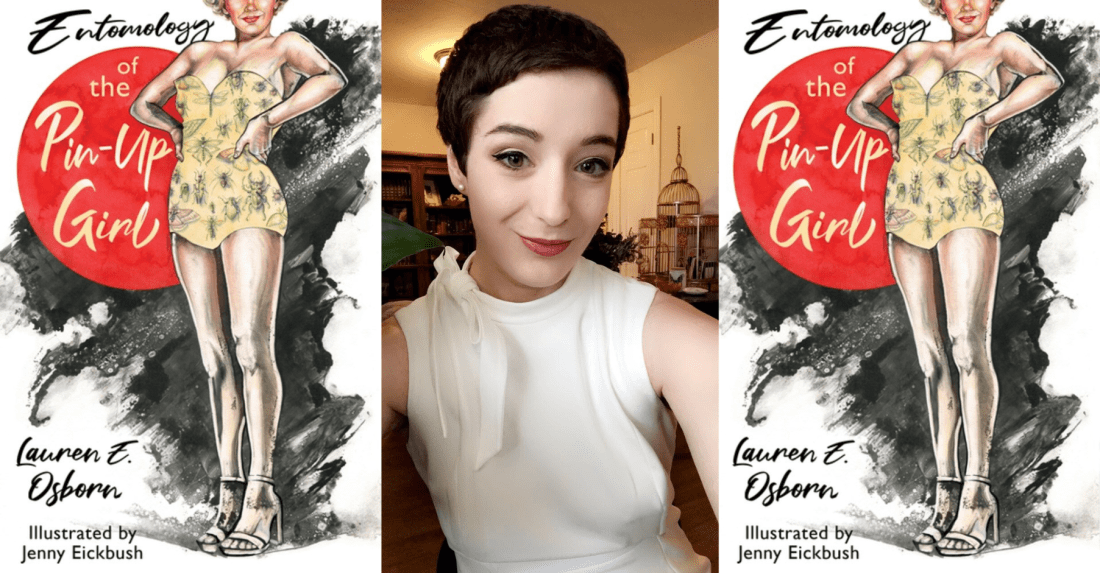
I had the pleasure of meeting Lauren Osborn at the Queens University of Charlotte in North Carolina, where we were both completing graduate programs in creative writing. At graduation, when she read her short story “Boy,” one of the 27 stories that populate her debut collection, Entomology of the Pin-Up Girl, I knew I would never forget her work — tart, gritty, and organic — or the delightfully arch way she read it aloud.
Lauren has a startling and strange sensibility that hits a sweet spot for me. My bookshelves are crammed with fiction and nonfiction about women who are wayward; women who are “up to something”; women who hunger, sometimes ravenously so, for food, for sex; women who run with wolves; women who transform into dogs or dragons; whom who are “good and mad,” who want to “burn it all down” or “blow their houses down”; women who are “untamed”; women who are “animals” or “creatures” or “monsters.”
Entomology of the Pin-Up Girl fits well in this library. It’s feminine, but not in the word’s traditional sense or meaning, as that word has been defined by men or by patriarchal society. It’s about all that is mighty, resilient, and adaptable in girls and women. It’s about survival. It’s about another way of seeing women. As readers, we are very much like the narrator in “Tarantula,” watching a “small, normal-looking woman” sustain bites and stings for the bizarre pleasure of onlookers at a local fair: “You imagine how she looks to the bee, filtered through the glass, through compound eyes, a woman turned monster by perspective.”
Indeed, insects of all kinds swarm these pages. But “entomology” here has shades of meaning. The one that intrigues me most — and the one that intrigued André Bazin, from whom Lauren drew her book’s title — is that of a field of study. If we devote time and attention — if we pursue, explore, investigate, and analyze — then we might see things in a new way. We might understand what it is to be a woman and what it is to change in form or nature in order to navigate our complex and often harrowing environments. In this sense, Lauren’s new book is not just a collection but an expertly curated cabinet of curiosities.
Entomology of the Pin-Up Girl won the 2024 Dzanc Short Story Collection Prize. Lauren’s other fiction and nonfiction can be read in The Los Angeles Review, The North American Review, The Adroit, Redivider, DIAGRAM, and elsewhere. She holds an MFA from Queens and a PhD from Oklahoma State University, and she is the 2025 Emerging Writer Lecturer at Gettysburg College in Gettysburg, Pennsylvania. She and I communicated via email.
The title of your book is striking. I understand that it’s also the title of a notable 1946 essay by André Bazin. And it’s the title of the first story in your collection. Can you say something about the title story or about why you selected its title as the title for the entire work?
I’m embarrassed to admit that when I first read Bazin’s essay, the pun of the title went over my head. I couldn’t figure out the connection between entomology and pin-up girls, and so I wanted to write a story to rectify this, which became the title story. (Sometimes it takes writing an entire story to understand a joke.) Since a lot of my writing already featured insects, women, and insect-like women, I thought it would be the perfect title to tie this collection together. In the end, it was very serendipitous. I give all credit to André Bazin.
Many of your female characters are or transform into creatures, often insects: woman as tarantula hawk, woman as boar or bear, woman as camel spider, woman as mantis, woman as bee. In “Gossamer Girl,” a girl is not a “singular spider” but a “cluster” of spiders. What is it about this metaphor that intrigues you as a writer?
As a writer, I was intrigued with the idea of a woman being able to fracture and recollect herself with the disco-like sparkle of baby wolf spiders gathered on their mother’s back. There’s also an aspect of practicality in that a cluster of spiders might better weave a human skin than a single, giant spider. At least, in my imagination.
The stories in your debut are what I would call “female-forward.” The male gaze is spurned. In “Hive Mind,” for example, you write about “how a man’s gaze builds up in a woman’s body like wax. How it clogs in the clefts of her throat. How it suffocates.” In “Swan Eater,” the female main character, now a camel spider, imagines meeting a male of her species: “he would drug her helpless with pheromones, chew his way into her womb, deliver his seed, and chew some more. Human men weren’t so different.” Can you comment on the girls and women you write about and their relationships or lack thereof to the men in their lives?
Much of the social insect world is matriarchal, which stands in stark contrast to the patriarchal structure of our current society. Subverting the male gaze through the lens of a female-dominated insect world highlights what I feel is an honest female experience for so many women — one that is often as overlooked as an ant crawling across the sidewalk.
There is a wealth of what might be called body or biological horror here, in which unnatural, graphic mutations and violations of bodies occur. A flower blooms from a woman’s shoulder. A man’s head — just his head — mushrooms from the ground. Some entity wears a husband’s skin like a wetsuit. Can you speak to your thematic focus on the body? On the corporeal?
I never envisioned it as horror. Horror, to me, is the human body in its natural form. What’s more horrific than this electric sack of meat we live inside? (And what’s more beautiful?) I like to defamiliarize the human body in my writing through surrealism. Hopefully, it makes the corporeal more interesting, and less horrific.
What do you think of the adjective “weird” being used to describe your writing?
Weird is good. Everything is weird when observed through an unfamiliar lens. However, I would label it as surrealism or slipstream. Maybe even strange. But weird works just as well!
This is a question for those of us interested in the craft of assembling a story collection. Your stories are separate, and can stand alone, but they feel very much part of a whole — a “web,” if you will. Can you comment on your process of choosing the stories to include and ordering them?
The word “web” feels fitting! Organizing the collection was probably the most difficult part of the process. The first story teaches your audience how to read the entire collection, so I began with the title story that touches on all the themes. Then, I had to solve the puzzle of arranging the rest. Final tweaks were made so that the illustrations were spaced evenly apart. Some stories that I initially included were removed because I think they might fit better in another collection. It was a complicated and messy process — but all art is.
Do you have a favorite image or situation or character? Which character/aspect of your book do you most closely identify with and why?
I wonder if all characters secretly exist within their writers. I can identify with each of them in some small way. I would say currently, my life most resembles “Two of Every Kind.” I’ll go out of my way to save an insect whenever possible and, fun fact, I once worked at a shopping mall and haven’t worn a pair of jeans since college. If I imagined each story as a visual portrait, “Exodus” would be my favorite. It has the most decadent imagery in the collection.
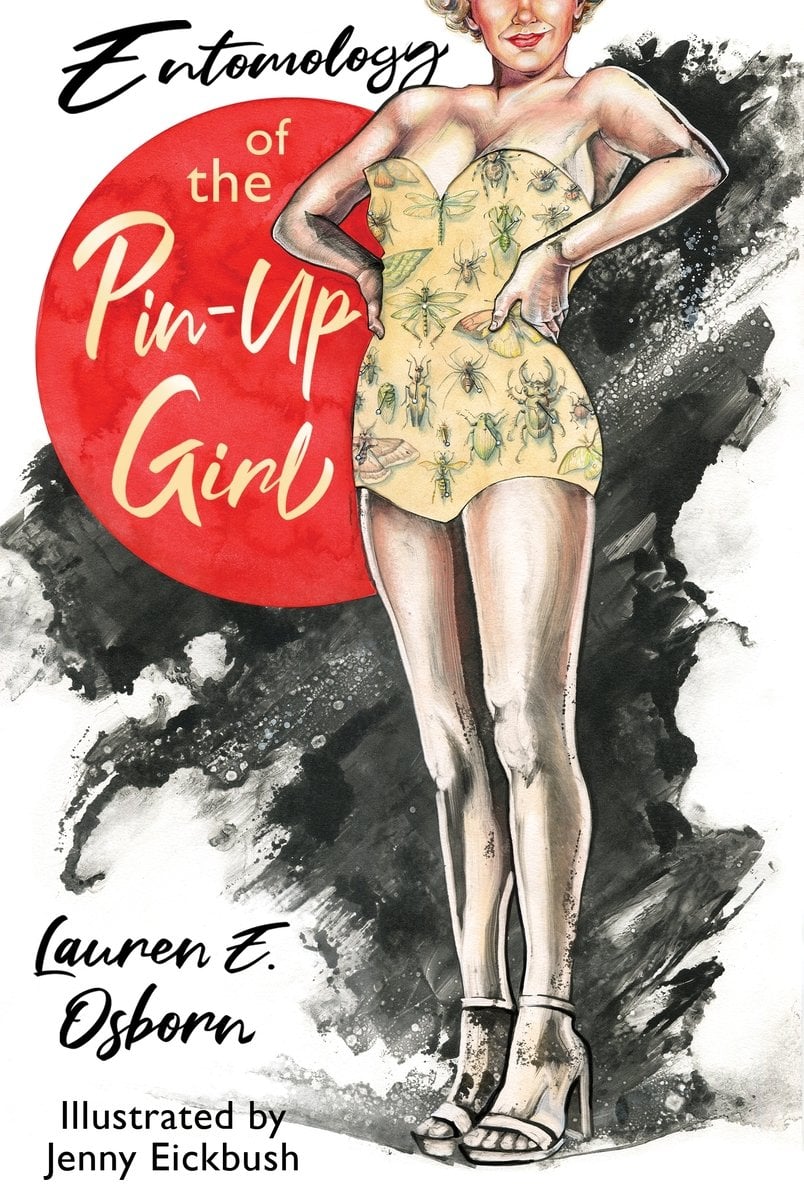
Jenny Eickbush contributed several illustrations to Entomology of the Pin-Up Girl. How do these illustrations support and enhance the reading experience?
Jenny did a lovely job capturing the surreal elements and symbolism of these stories. She’s so incredibly talented and I feel fortunate to have her art in conversation with my own. Her illustration of “Ecdysis” is framed proudly in my office.
And here’s a fun one: If you had to make a playlist that captures the tone and feel of Entomology of the Pin-Up Girl, can you name two of three songs that would be on it?
What a great question! I haven’t thought about this one since I typically write in complete silence. Otherwise, I can’t hear my thoughts. The sounds of nature would be most fitting for the soundtrack. The scream of cicadas, the rustle of leaves, and the buzzing of flies and bees.
FICTION
Entomology of the Pin-Up Girl
By Lauren E. Osborn
Dzanc Books
Published May 12, 2026


